Sunday, February 9, 2014

Lunch with Little Red Riding Hood and the Wolf

February 9, 2014

We’re off to the South in about an hour.  Quick trip to the airport, which is often super crowded but we are flying mid-Sunday and though busy, it’s not hours long to get bags checked or through security.   Security is different.  You don’t have to take electronics out of your cases nor take off shoes and belts.  Very civilized.

Tim got stuck in horrendous traffic yesterday coming to Valparaiso to pick up us for lunch and then the trip back to Santiago.   The freeway was so crowded that it took him nearly four hours to negotiate the 100 km. (65 miles).  It’s a trip of normally 90 minutes.

Anyway, we left the Hotel Thomas Somerscales, named after an Anglo-Chilean painter, who specialized in portraits and marine scenes about 100 or so years ago.  At least one of his Chilean marine paintings is in the Tate.  The hotel was lovely, service was superb, in a very nice section of Cerro Allegre, though a stiff uphill walk from the local ascensor.   The breakfast was good and the bilingual staff was helpful with dinner reservations.   The room was excellent with an ocean view and an expansive vista  of Valpo’s tin roofs.  Every afternoon the wind came up and blew strongly until about midnight.  The room was cooled off to make sleeping under the covers necessary.  

We lunched yesterday at La Caperucita y el Lobo (Little Red Riding Hood and the Wolf) looking over the bay and the city.   The food was excellent, though Ben and Tim were disappointed with the pinot noir.  They both gave it four points out of a possible ten.  A harsh rating, thinks John.   We started with salads and crab cakes, then Tim and John had Chilean hake, merluza, and Ben had two more starters, crab cakes and scallops.  He thought the scallops with their roe were out of this world…and even the chef stopped by to ask who was having them because even he thought they were superb!
We had a run around the city and then back to Santiago.

On our trip back we stopped at one of the small restaurants just off the freeway to pick up empanadas for dinner, baked and stuffed with meat, eggs and whole olives.   We enjoyed them in the back garden, talking till midnight, with a bottle of Calcu rosé that is one of Tim’s favorites…and ours.


Saturday, February 8, 2014

Valparaiso, a last day.

Hill top cemetery
Saturday, February 8, 2014
Fruit market

Today is our last day in Valpo.  We leave for Santiago this afternoon after lunch and then tomorrow head down south.   Valparaiso is a pretty place, the bay curves along the coast, the town creeps up the steep hills, the people are friendly—after all it is a port city and quite cosmopolitan.  It is not large, though, and we’d say that two days is really enough to hit all the high points, ride the trolley busses and eat enough local food.

In general, we’ve found that Chilean food is not particularly interesting   There are good restaurants, many of which we have eaten at, but ordinary food is boring.   A couple of quick lunches in Valpo proved that the often-sold empanadas have crusts like cardboard.   The completo, a huge hotdog, that John had for lunch (the Napolitano, it was called) was probably the worst frank he had ever had.  Slathered with guacamole and mayonnaise while inside the doughy roll was an under-spiced frankfurter, more bland than supermarket bologna.  But neither of these lunches was expensive.  Yoghurt here tends to be runny.

Our restaurant last night purported to be French, was cash only, and didn’t have two of the wines on the list we thought we’d have liked.  We did enjoy a Valdivia reserve sauvignon blanc, nonetheless.   The food was good, but it wasn’t French…no French spices to speak of.  Nonetheless, le Filou de Montpelier (The Swindler of Montpelier) had good food:   with appetizers like lox served with blood sausage (!) and a salad for Ben and serrano ham with salad for John, which were very good.   The amuse-bouche of homemade pâté de foie was fun.  And the mains were very nice, though not quite French.  John’s ostrich steak could have used a great deal more black pepper if it had had any on it to begin with, while Ben’s filet de reinata, the local white fish, was excellent, but much more Chilean in style than French. Both came with braised sweet onions.  The baked potatoes in foil were a mid-century touch!  Always potatoes.

A highlight of the day was visiting the Museo des Belles Artes housed in a restored art deco mansion.  Most of the art was 20th century Chilean.  We particularly enjoyed the portraiture and some of the contemporary sculpture.

We did a lot of walking yesterday, hence a collection of pictures from all over the city.  The backs of our calves told us last night that we had climbed many a hill.   All in all a very pleasant three days.  
Kids on rented trikes at Plaza 
Plaza Bolìvar
Belles Artes Sculpture
Calf-threatening walkway
Wild dogs everywhere, but not in the midday sun

Friday, February 7, 2014

Foaming Waves, Foaming Food


Friday, February 7, 2014

We went to the seaside yesterday.  Well sort of.   We did our excursion on the antique trolley busses—the same age as the busses John rode as a child in Providence, Rhode Island in the mid 1950s.  They are still fast, a bit jerky and fun.  Pay cash (about 50 cents)to ride, which is good since we didn’t buy transit cards here.  Trolley bus stuff is everywhere! 

Then we decided to see the seals.  From the trolley terminus there are motor busses every 30 seconds up the beach road (a six lane affair) heading to Viño del Mar.   About two miles up the road is a huge fish market, fishing fleet and piers.  One was closed off to shoot a movie, but the other was the home of the seals, cavorting in the waves looking for lunch, along with thousands of gulls and a few pelicans.  In the market, we examined lots of fishes, including the local reneita, a hake like fish that we had the other night for dinner.  We also looked over many many different kinds of shellfish, from scallops with roe to crabs that grow like rocks.  

Then we took the busses back, and had empanadas for lunch, which tasted like cardboard, and then Ben had good cappuccino at the bottom of the Reina Victoria ascensor.   Home for a lovely afternoon nap and then readied ourselves for the meal last night at Al Alegre.

La Reina Victoria Incline
Aimee, Mitzi and us
We met Aimee and Mitzi at the restaurant and began the tasting menu that took well over two hours.  John is trying to remember all the courses:   a pisco sour of lemon foam, then small puff pastries with mint sauce, skin of salmon deep fried, a small urn of caramelized tomatoes with chopped chicken, smoked salmon with beet foam and pickled celery, wagyu beef, chopped and rolled in a potato pancake and served with seafood fried wonton, pastries for dessert—macaroons, maple sugar cubes, mint sugars, and then a digestif that is local to Chile.   We enjoyed the food immensely but found the wines designed to go with the courses a bit off track.  We did not enjoy the espumante, and felt that the timing of the chardonnay before the sauvignon blanc was out of place.   No reds to go with the wagyu beef.  Fun, but as Aimee, a chef, said,  Sergio Barroso, age 28, who apprenticed under Ferran Adrià at El Bulli in Spain is cooking like Adrià when he cooked 10 years ago.  The artistic plating and textures were gorgeous.  Both of us think that it was not as grand a meal as Attica two years ago in Melbourne, Australia, though even that tasting menu had a couple of rough edges too,  (That meal was significantly more expensive than Al Alegre.)  

Home to a view of the city from the widow’s walk and to bed.   


Thursday, February 6, 2014

Valparaiso: Ups and Downs

Thursday, February 6, 2014

Winery in Casablanca Valley
So Dry
We left Santiago on the  cheap ($7 each--they run every 15 minutes) Turbus for Valparaiso, a two hour trip through dry, sunburnt hills and lush agricultural and vinicultural valleys.  Two long tunnels, stops for the basket lady to come aboard and offer drinks and sandwiches then depart;  tickets actually checked and luggage stowed by a real human who also boarded and debarked.  The views, some interesting, some not so.  The lush vineyards make a California-style picture when coupled with the golden, or scruff brown hills.

1940s trolleybus
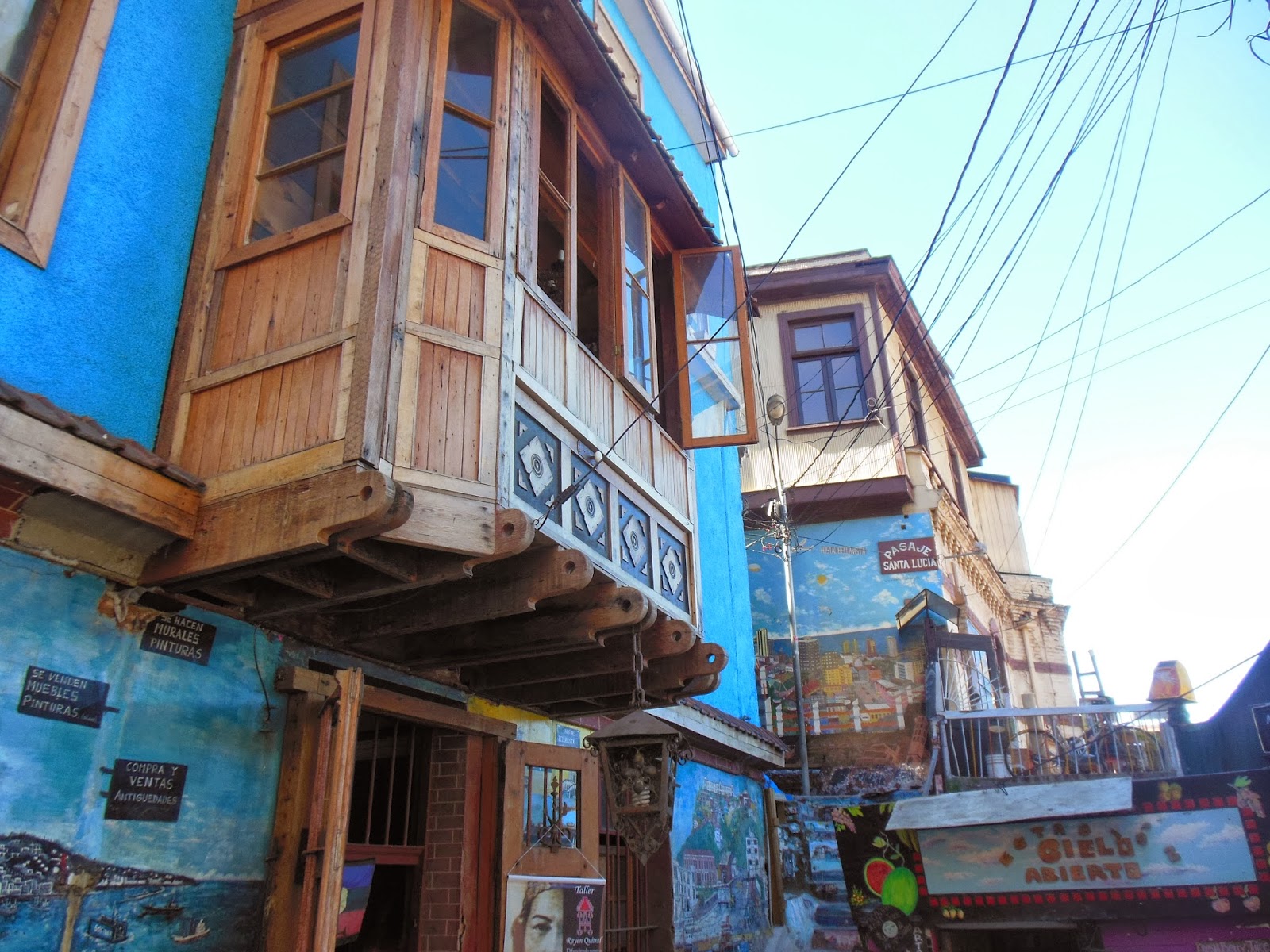
Valparaiso itself is a hill-climber’s paradise.   The city has one short section of flat land about two or three streets wide, depending on where you are on it, that was the original city.  It houses the port, which is huge, and the trolleybus network, which isn’t.  The rest of the city is totally upendicular, rising above the plain of the port.  Nestled in valleys, climbing over peaks. there are streets and alleys of brightly colored houses, many very, very old, with wide vistas of the Pacific Ocean.  It is, without doubt, one of the naturally prettiest cities we have ever visited.    

Atop Cerro Concepcion
We did a short walk to the nearest ascensore, the Valporaisian word for incline or funicular, that run at 60 degree angles from almost all the hills to the city center.   They are very efficient, but very tiny, holding perhaps a maximum of 10 per trip.  They were, nevertheless, not crowded.  Rising from the station to the hilltop in about two minutes is quite a trip in more ways than one.

 Valpo Port
Our hotel, The Thomas Somerscales, is an old mansion turned into a boutique hotel—something quite common on Cerro (Hill)  Alegre.  It has sweeping views from some rooms, more limited with the ocean and the corrugated iron roofs of the city from ours, and a panoramic widow’s walk at its top.   From there, 360 degree view of the bay, the town and the mountains and the huge port with its cruise liners, container ships and military vessels.  Valpo is the home of the Chilean Navy from what we could gather.

Rumanian Music Video Shots
The city is so unique that we even watched a Rumanian cameraman shoot a video for Rumanian consumption in front of one of the murals on Cerro Alegre, on the street where we are staying.

We have found the food to be interesting, I suppose, but rather bland.  Our first stop was El Desayunador, the Amiral Montt Street’s local lunch and breakfast café, for a quick lunch.  The sandwiches were exactly what they were supposed to be…round Valpo loaves about 15 cm/6 in. across with goat cheese and salami for John and a mix of cooked green and yellow peppers and shreds of chicken for Ben.  More interesting for Ben was the honeydew melon juice he ordered as his drink.  The goat cheese and the salami met standards, though salty, but the chicken sandwich was dull.

Our second food visit was the Cocino Puerto, highly recommended.  It’s in a quaint old house, no views, and offers excellent lemon (pico) pisco sours and a good wine list (a Las Niñas Chardonnay was the choice).  Our first course was rather fun. It was a tureen, about 6 inches across filled with mussels, fish pieces, shrimp and melted white cheese in a broth.  The cheese was like a mozzarella swirling around our soupspoons as we ate the dish.  (Right now, John cannot remember its name.)   It had little spice except for a large chili pepper that John ate but Ben found too strong for the meal.  It was not a hot Thai pepper, which we are very used to.  Cooler than that.

A city full of old buildings of class
Then to the main course, which was the disappointment.  It was like a Portuguese cataplana, a tightly covered casserole dish containing a mixture of meats and fish.  While the Portuguese use local clams in abundance with pork loin, the Valpos use a chicken leg—thigh and drumstick—then a relatively mild longanaza sausage, two slices of smoked pork, a large handful of mussels, a few bits if shrimp of various sizes, and very large pieces of potatoes.  The whole amount was covered with one very large cabbage leaf and clearly cooked till it was almost English in taste—dull.  Additions of salt and black pepper added a bit of razzmatazz but it was not to our taste.

Cerro Alegre Street Scene
Along the way, the evening picked up with the addition of Mitzi, a rancher from Idaho, and her daughter Amy, a luxury yacht chef, who are traveling Chile together for a few weeks.  We enjoyed their company   Amy travels around the world working on yachts and lives in Majorca.  Mitzi, recently widowed, raises cattle in the Salmon River Valley in Idaho.  She grew up in Salt Lake City and, though she did not know him, was a high school classmate of our daughter Anne’s Uncle Nick at East High School!  We found this out as we were discussing our travels, including discussing where we got stuck on a snow bank at Wolf Creek Pass in the High Uintas about five years ago.  She had lived many years in Park City, about the time Nick and Anne’s aunt, Robbie, had lived there.  Small world.  Her family is not native Utah though—from Illinois.

We drank an extra bottle of chardonnay from Casablanca valley, at Mitzi’s courtesy and closed the Cocino down at midnight.  They will join us for dinner tonight where we will celebrate Mitzi’s 66th birthday at the Alegre Restaurant doing a tasting menu from a chef, Sergio Barroso, age 28, who apprenticed under Ferran Adrià at El Bulli in Spain.  


Wednesday, February 5, 2014

Contemporary Art and Contemporary Food


These dogs continue inside

Santiago, February 5, 2014

We depart for Valporaiso today at noon.   We look back on our five days in Santiago with pleasure.  We have enjoyed this capital and seen most of the tourist sights and parts that are unknown to most tourists.

Art Museum
Vitacura, Tim’s neighborhood, is very upscale and could be in any city with a climate like this.  In many ways it has reminded us of the upscale suburbs of Los Angeles or parts of the Peninsula south of San Franscico with its well-trimmed gated homes and sprawl.   Vitacura also has a good collection of restaurants and excellent transport to other parts of the city.

Yesterday we headed downtown to the Bellavista area of town to the central park, home to the National Museum of Art and the Contemporary Art Musuem.  We spent a while in the Contemporary Art Museum at a show called Trasnochada, which we couldn’t translate, but assume to be something about the art that underground artists produced during the Dictatorship from 1973 to 1980.   One piece that John found astounding was a collection of toys, from Lego to Bibindum, the Michelin Man, all laid out on a plank, marching forward, and all with masks on their faces—to remain unknown.   
We lunched at Wonderful Cafe, Ben getting his XXdry skim cappuccino to go with his bowl of assai and yoghurt (assai=açai, a fruit).  He enjoyed it while John enjoyed his Montreal bagel with excellent lox, cream cheese, onion, tomato and capers.  

Back at Tim’s home, we rested around the pool for a couple of hours, did some reading and then headed out to dinner at Miraolas, one of the city’s best fish restaurants, about a ten minute walk from here.   None of the waiters spoke English, and we were the only English speaking people in the room, as far as we could make out.   They did have menus in English, though.

Razor Clams
John enjoyed a national cocktail, the pisco sour to begin.  It’s excellent.   Then we got a lovely sauvignon gris from Leyda Winery to go with the shrimp John ordered and the sweet tiny razor clams Ben chose.  These were completely unlike the razor clams on the US East Coast.  They were rounded, not straight edged.  Very sweet, and served with a mozzarella cheese melt.

Main courses were reineta for Ben, which is hake we think, served with  a concasse of tomatoes, garlic and oil.  John had sea bass txerliche, which is a Basque dish of grilled bass with a sauce of squid and squid ink.   Very mild, very soft on the palate.   

And then home to bed.


Tuesday, February 4, 2014

Hills and Wines

 Tuesday, February 4, 2014

Yesterday was wine day.   We ate fabulous food and tasted seven Chilean wines varying from two sparklers to pinot noir, and three whites, two sauvignon blancs and a chardonnay.   We finished with a carmenère.  

So to begin,  we met our host’s friend Danilo at the house and walked from there to the Mestizo restaurant where we had tried to eat on Sunday in Parc Bicentario.  We sat on the terrace overlooking the hills of the park, golden like the hills around Los Angeles, and even saw some of the local pink flamingoes…apparently they are pink from the grubs they eat in the ponds where they live.  There is a group of glider enthusiasts who use the hills as well.  We watched them towed around by a prop plane before they took off in the vectors.

Lunch started with a sauvignon blanc from the Amayna Vineyard near Santiago.  Excellent.  Not so dry and tart as a Marlborough New Zealand or a Sancerre from the Loire, but very nice.   The second, which we did not write down, was pleasant but fuller, more in the style of an Italian chardonnay.   Lunch—well, we started with three tapas size plates.  Grilled octopus on a bed of thinly sliced potatoes with salad; loco, a local form of abalone, with light lettuces and very small cubes of boiled potatoes; and Chilean empanadas, two of spicy ground meat and two of light almost runny cheese.   After this we had three salads—with varying toppings.  John’s was shrimp and squid tempura style, Ben’s was covered with sliced ahi tuna and  Danilo’s had sliced salmon and salmon croquettes.  


After this filling lunch, we headed off to Cerro San Cristobal, a large hill rising about 300 meters from the city floor—the floor is about almost 600 meters above sea level…that means were were about 3200 feet up—enough to make ears pop at the top of the hill.  The views of the Andes, as well as the city, at that altitude are grander than any we have seen before.  As the Andes range in the distance, you can almost feel the glaciers melt.  Haze from the summer dust gives them an ethereal atmosphere of blotches of white—the glaciers—to the golden brown of the dry hills all softly defined by the summer air.  Not crisp but fine.
After our day in the park, climbing almost to the Virgin Mary who stands atop the hill with her arms open to all, we hopped in a rush hour taxi for the cheap (taxis are very cheap here) ride to the house. The incline railway (funicular or ascensore depending on your language) was unfortunately inoperative. We also overdosed on sugar, almost diabetic shock, with a mote—this is apricot juice over a dried apricot, often served with cereal in the bottom of the glass and eaten with a spoon.  Without the cereal a really sweet treat, with we think we could do without.

As the evening began we took the bus and then the metro down to Barrio Lastarria to the Bocanariz (Mouth and Nose) wine restaurant for dinner.   Lastarria is a pretty street of restaurants and strollers, said to be one of the “in” barrios of the city, where we had walked on Friday.   Our host Tim is friendly with the Bocanariz owners and arranged for a table for us right next to the sidewalk just inside the restaurant.  The interior walls are covered with wine lists and corkscrews!  The wine list is huge at 362 altogether, ranging from inexpensive flights of wine to bottles in the cellar that range up to 800,000 Chilean pesos (about USD 1,500)!  We saw them after dinner in a tour of the cellar.

Dinner started with two tapas, one of salmon roe with guacamole.  The roe was served on a cornet of crisped egg roll wrapper with creme fraîche in the point under the roe.  Very light and very nice.  John may well make this at home.  The other tapa was a small plate of Chilean oysters.  These are very sweet but they are tiny, no more than 2.5 cm or 1 inch diameter.  Rather than scream as you eat them, they are so small they only make a slight squeak.

The mains were shell pasta stuffed with pignolis and various vegetables for Ben.  The dish was light, but it had a creamy sauce that made it very substantial in taste.  John had conger eel on a bed of mushrooms, artichoke bottoms, little boiled potatoes and sliced miniature zucchini in a short broth.   Very tasty.   The eel had been grilled.  Small potatoes are ubiquitous here.  

The Chilean wines were very interesting, all very fine, but some of them quite different from what we expected.   We accompanied our tapas with two sparkling wines, a rosé and, the second, a mix of pinot noir and chardonnay.  We preferred the mix, though the rosé was lovely.   Sweeter than John expected, and not so dry as the sparkler Tim served us on Friday night.  The second set were a pinot noir, which they serve cold here, and a chardonnay.   The pinot noir was lovely.  It had a very nice nose, quite full in flavor, and just what Ben wanted.  John’s chardonnay was excellent too.  Since Chile’s signature wine is carmenère we thought we should finish off with one, but the sommelier didn’t speak too highly of the varietal and only had three in the cellar.  One she described as light, the second as rather sweet and the third full in the style of a shiraz.  We had the third which we enjoyed, but I look forward to trying more in Valpo.

We head off to Valpo a day early tomorrow morning and return to Santiago on Saturday before heading down south to Punta Arenas on Sunday.  This will reduce hassling transfers on Sunday morning and give us a chance to enjoy lunch on Saturday in Valpo with friend Tim and then another fine night in Santiago before we leave.

And now to the Museum of Contemporary Art….


Monday, February 3, 2014

Vitacura

Bernardo O'Higgins, Founding Father

Municipal Center of Vitacura

Skyline of Santiago, Providencia

Monday,  February 3, 2014

We head off around the city with our host’s friend Danilo this afternoon.   This morning we enjoy a bit of quiet.  Yesterday, though, was rather busy with a trip to San Miguel, a working class suburb south of the city.   That was where the woman who found my passports works.  When we arrived she sweetly produced them and did not want the reward for finding them.   John pressed her and she accepted.   She is in her mid-20s and very pleasant.   An hour to get there, two minutes in the huge El Lider grocery store that felt like Wal-mart.  

San Miguel and environs are definitely the other side of Chile.  Not poor, but not well-off.  Much like the less wealthy parts of the US, but more extensive, miles and miles and miles.  And since Chile doesn’t get rain, to speak of, during the summer months, dusty and harsh.

Not the same in Viticura.   We spent a good bit of the afternoon exploring the Parc Bicentario near Tim’s home.  It’s a grand expanse of riverfront, really an arroyo, with no water in it, well planted with indigenous and imported flowers and bushes.  And a grand view of the Andes.

It’s also a statuary center.  We found the statue of Bernardo O’Higgins, one of the founding fathers of Chile, and several other war heroes.  The interesting municipal building, a three sided triangle was quite unique.

Andes from Park Bicentario
Red, black-necked Swan and green billed duck