Monday, February 20, 2012
Lamb at Lamb's
Sunday, February 19, 2012
We love NY
Wednesday, January 25, 2012
A rainy day in Sydney
Our last full day in Australia and the heavens decided to turn the place into London. It’s been warm and muggy, but rainy all day long. We walked from Oxford Street through Sydney’s Paddington district, a neighborhood terrace houses, probably ranging from 1830 to 1900. We ended up in Kings Cross, just as the rain began, eating Thai and Hokkien noodles and then taking a train back to Strathfield. We did our minimal shopping for products not available States-side and now await our dinner with Jeannie, James’ mother and the girls’ grandmother.
Last night we had dinner at La Cucinetta, a formal-ish Italian restaurant on a hilltop in Woolwich, one of Sydney’s very lovely older suburbs with houses on large estates. The restaurant lived up to expectations with yabbies in oil and spices as our starters (entrées in this country), and then Ben had John Dory and John had a veal shank. James and Priscilla had invited her sister, Denise, and her husband Trent to join us. Very good conversation. Denise is expecting number 3 in April, and can hardly wait
The wines ranged from a pinot grigio , that was excellent, a pinot noir from Tasmania, and a shiraz from Margaret River in Western Australia.
The site is above a World War II drydock, now turned into a yacht basin, cut into the side of the
The city glimmered in the distance as the sun went down.
Tonight we dine with Jeannie at home and then it’s off to our home tomorrow afternoon.
Tuesday, January 24, 2012
Sydney, Botany, Manly and Meals
January 24, Tuesday
We’ve been a bit busy so there have been no entries since we arrived in Sydney. The Currans have kept us very very occupied.
The bus ride from Canberra was uneventful, though the stop of Goulburne, to get coffee (acceptable) at the local award-winning bakery, and two sausage rolls, was interesting in that a huge ram is stationed near the Hume Highway interchange, about 50 feet tall. It had been moved from downtown when the freeway was built and now sits over a 7-11 and a Shell station in a typical plot of urban sprawl.
We arrived at Strathfield, a huge suburban railway station, reminiscent of Clapham Junction or Secaucus to meet James and a quick run to their home in Burwood Heights, an established Sydney suburb. Strathfield itself is Koreatown, with streets of Korean grocery stores and restaurants. The smell of kimchee was quite exciting.
The first night we just spent the evening talking. Priscilla is starting a new job so she was a little worried about it, but it has gone well. She started yesterday. And Ella and Pia are growing up. Ella is six next week and Pia is eight. Both of course are delightful young ladies.
James cooked an exquisite piece of lamb and started us with a lovely shrimp dish with mild chili peppers on toast. A De Julia sauvignon blanc from Hunter Valley for the first course, and a Calambar Seppelt Shiraz from Victoria’s Grampians, mountains in the center of the state. Much more conversation and to bed.
Sunday we headed off to Manly. This is quite a trek because Sydney sprawls like most Australian cities over many hills and valleys away from the the Harbor. We took a suburban train to Circular Quay downtown. While Australians complain about their transit systems, Sydney’s trains are excellent. From Strathfield, the trains to downtown Sydney run no more than ten minutes apart, even on Sunday! We got off at Circular Quay to find the ferry to Manly almost ready to board, so we made our way through the crowd of Sunday beachgoers to get seats aboard outside.
The run across the Harbor is grand. Soaring over one side of Circular Quay behind the Rocks is the huge Harbor Bridge. Atop it stand two huge Australian flags, and along the walkway, cresting the arch, were dozens of people who walk over it, up to the very top, Not for us, but they look to be having a fine time. On the other side leaving the Quay, was Sydney Opera House. It’s beginning to show that it’s many years old, but it is still a very interesting structure. A titan of a cruise ship, the Rhapsody of the Seas was readying for a cruise at the Quay too. Those ships are gigantic and the Rhapsody is not one of the largest. It’s only 70,000 tons and only 300 meters long. It only holds 2400 passengers on its Australia-Alaska cruises. Only....
Manly is 40 minutes ride aboard a fast-moving ferry. Unlike Auckland, these ferries are not catamarans, but they are double-ended so they don’t need to turn around. They just arrive at the dock and then the skipper moves to the other wheelhouse. Debarking and embarking takes about 10 minutes.
Manly was a crush of people, though not overwhelmingly pressured. We walked the mile from the ferry to the beach where the local radio station was running a series of sports-events for the subteens. There were surf boat games in the distance and the waves were rolling in strong enough to surf on them with boards. The streets were decorated in preparation for Thursday’s Australia Day celebrations and there was a large amount of eye-candy around. Even a few speedos.
John had an Australian Burger, which comes with a slice of beet(root) and chips, Ben had a poppy-seed bagel with grilled chicken and vegetables. A good sandwich, but not a true bagel. John had a James Squire ale to go with his.
We walked back through the town, the girls got ice-cream and then off to the boat. Coming back across the harbor many groups of sloops were taking part in Sunday’s regatta. One of a group of spinnaker-powered sloops actually capsized in the harbor, but the two-man crew managed to right it.
We crossed paths with three tall ships too, coming to Sydney, we guess, for Australia Day. The first was coming into the harbor from the Pacific. We’d seen it from Manly beach, with all its sails full. The second was in the harbor and the third was moving under motor power with only its jibs up near Luna Park under the bridge.
A quick railway trip home from the Quay and then off to the Elms’ for dinner. Elwyn and Silvana, Priscilla’s parents, live in a huge bungalow with an Italianate garden designed by Silvana, who was born Italian.
They had been to Washington and we had enjoyed their company then. Silvana did a lovely Italian meal of olives to begin and then shrimp followed by Italian style eye round of beef and a huge Pavlova for dessert. We could get addicted to Pavlova, a sweet meringue topped with fruit and whipped cream--and a battlefield over possession between Ozzies and Kiwis.
Yesterday, Monday, Priscilla had to work, and the girls went to Silvana and Elwyn’s for the day, so James took us to see the University on its hill overlooking the city. We met the former premier of Western Australia, Jeff Gallop, as we crossed the quadrangle. He’s now professor of government at the University. A close friend of Kim Beasley, who’s Australian ambassador to the US. A very interested discussion of American politics with him.
The University was founded in the 1850s and is very grand. Its quads are more reminiscent of Princeton than Brown or Harvard, very gothic. Yesterday was registration day for the pharmacy school so there lots of students in lines, but not the hurry of students going to class.
The museum had a fascinating exhibit on the Etruscans, about whom little is really known, but it appears their language was not Indo-European and no one knows how its grammar worked. It has been written in Greek letters, so we have a rough approximation of how it might of sounded. Only about 400 words are known, though.
We had coffee, which met all specifications, at Toby’s with sandwiches and then walked through the Glebe section of town, passing an old closed-up department store, now student housing, called Grace Brothers! Are you being served?
Glebe is a very old neighborhood of colonial-era terrace houses, many very small. It’s clearly gentrifying but also quite ethnic and houses lots of students. The streets are narrow with the major ones lined with cafés, bookstores, upscale shops and, according to James, an occasional brothel.
Dinner last night started with Tasmanian camembert, which was superb with its fig jam spread. Then we moved on to the best Italian sausage from Summerhill with pasta and a Sangiovese. Dessert was ice cream. We also had a lovely Martinborough pinot noir too.
Priscilla’s dad, Elwyn, had volunteered to take us to Botany Bay. We took him up on it this morning to see where Captain Cook had landed and Captain Arthur Phillips brought the first of the convicts to settle New South Wales. Botany Bay today is a container ship port with hug vessels going in an out daily. But the area where Cook and Phillips visited and had the first fatal encounter with aborigines today is a national park.
It honors both the aborigines who saw their land taken by the Europeans and the Europeans who built the modern state.
Cook came to Botany Bay in 1770 and Phillips returned in 1788. The vessel did not stay, in fact moved up to Sydney where the first colony was built. Botany Bay, to Cook, appeared to have meadows and water, but the area he thought were meadows were marsh grass and the water supplies were insufficient.
We drove out to the headlands and looked out for whales, none to be seen today.
We also visited Laperouse, a town today, but originally the site where Capt. Lapérouse landed a few days after Phillips and left to be never heard of again. It’s believed his flotilla of ships went down in the Pacific in 1788. There is a monument in French to him, and a grave for the first European to die in Eastern Australia, a priest. Père Receveur.
We returned to Elwyn and Silvana’s home, came back with Priscilla and James and are readying ourselves for dinner at an Italian restaurant in Woolwich, the Cucinetta.
Saturday, January 21, 2012
Melburnians and Canberrans, Trains and Trams
January 20, Friday
John says he takes back whatever he said about Canberra being dull.
We had a fine day today exploring the monuments and edifices of Australian democracy in this planned capital. Now, remember, this is a government town. It’s a metro of about 350,000, which means that it’s a company town, dedicated to government, and the educational establishment at the Australian National University. But in its own way it’s got charm. Lake Burley Griffin, named after the American architect who designed the capital, the series of circles and broad boulevards, which feel lik
e broad boulevards, the shrubbery and forestry, the distant hills and the grand buildings, all make it an imposing city.
In it are fine places to visit for historians and government junkies, like us. The aboriginal art exhibit at the National Gallery of Australia is magnificent. It is so intense that it is overwhel
ming, from the collection of coffins standing like digeridoos on the first floor to commemorate the Aborigines loss of their lands and lives to the settling Europeans to the paintings from the Patunya times that we recognized by style and content from our visit to the exhibit in Melbourne. Coupled with the settler Australian art that is a time-line from discovery to modern days, particularly Russell Drysdale’s magnificent work The Drover’s Wife, the museum gave us a fine overview of Australian culture. The Drover’s Wife, incidentally, was given to the gallery by Benno Schmidt, once president of Columbia University.
From there we walked across one of the city’s many parks, to the Old Parliament Building that dates from the 1920s when Canberra became the capital city. The building is done in 1920s basic style and truly isn’t very charming. There is nothing magnificent about it. The Senate and House chambers lack vitality and it is merely an historical site. Our host shared with us that it may have been done so simply because the rich cities of Melbourne and Sydney had both lost out to the upstart new capital and were not pleased and not interested in making it at all glamorous.
After lunch at The Pork Barrel (the same words we use for the same acts) we walked to the new Parliament Building up the hill. This is a very strong 1980s statement about Australia, almost strident in its strength from the building’s growth out of hill on which it sits, overlooking the whole city, to its aluminum four-part tower on which flies the Australian flag. It is, unlike our own Capitol (even before 9/11) completely approachable by the public. Though our host says it is considered a bit on the small side now, for all the work that goes on inside, it has an interior grandeur, with a lightness of touch, that meets with Australia’s place in the world today. The House is done in light blues and tans, while the Senate is more formal in shades of dusty rose. And its roof commands a 360 degree view of the entire basin where Canberra sits.
We are staying with our friend Tim, who lived in Washington when he worked at the Australian Embassy and was a constant and well-liked visitor in our home for nearly three years. We had promised to visit him in Canberra and he is making us very welcome. We had a good dinner at home with lovely Tazzy champagne last night, and a superb McLaren merlot and a roast beef loin. MMMM...
Our night before with Andrew and Angie and their sons Hugo and Angus was a hoot. Their home in Hawthorn was a train ride from the city--all ten minutes of it. We quaffed several wines, including a Saint Clair NZ sauvignon blanc we’d picked up at the liquor store, a Geelong Bellarine chardonnay, and then two lovely red wines and a sauterne like dessert wine. This was coupled with conversation that ranged from finance to education to American and Australian politics. They walked us to the tram to get home and we were in bed by midnight. Although Melburnians disparage their transport system, it is superb until after midnight when it virtually stops.
Andrew and Angie have visited us in Washington with their sons, ten years ago, and we saw them at their place in Fairhaven, down on the coast, our last visit. We enjoy their company. Wonderful, too,to see how the boyts had grown up.
The following morning we arose, said our goodbyes to our excellent host Ian at 169 Drummond BnB, and headed off to Southern Cross Station. The train ride to Cootamundra was excellent. The countryside is mostly ranches and fields as the train travels through small towns, stopping at only a few. Unfortunately we did not have a train all the way from Melbourne to Canberra because there are none, so we had the last three hours on two lane roads through small villages on a bus.
Pretty but uncomfy to say the least.
Tim met us when we arrived and immediately showed us the town. Then we went searching for kangaroos, which we found eating the grass and flowers at one of the cemeteries. They are truly a strange animal. Generally not afraid of humans. The joeys were a bit too big to fit in their mothers’ pouches, but they were trying. These ‘roos were not large, unlike those we had seen on previous visits, but John still wouldn’t want to be jumped on by the legs on a roo standing a meter high.
Tonight we are off to a restaurant for dinner. More to come. Tomorrow it’s to Sydney, our last stop before our return to the States, to see the Currans who lived up the street from us in Washington for six months.
Saturday, January 21
Last night’s meal was at an aerie of a restaurant named OnRed, perched on Red Hill overlooking the glittering city. It was an elegant place to sit and talk and even more fascinating when the night-time thunder storm rolled through the valley with fiery lightening and sheeting rains. It’s a circular restaurant with views in all directions. The food was small plates, excellent tidbits. We started with a Victorian BWE Pyrenees champagne , then moved on to the tapas with each of the six of us having three each. They ranged from goat cheese, the spinach filled ravioli with ricotta to duck, sweetbreads and even pork belly crisped up. The wines to go with were a Bourke chardonnay from the Canberra region, which was excellent, and a Locan Pinot Noir, also from Canberra, from Bunengdor.
What made the evening so enjoyable though was the company. The guests included Jennifer, whom we’d known in Washington when she had been the ambassador’s private secretary. She had returned to Canberra from Washington to retire, but changed her mind, has been working for the Australian official assigned to ASEAN and is now going to Tokyo for two years. A far cry listening to her on her prospective move compared to the Thanksgiving dinner we had with her about five years ago.
The second guest was David, a friend of Tim’s who is leaving for London to work in the High Commissioner’s office with his wife and kids. David had just been honored by the Peruvian government for his work, and the other guest was the Ambassador from Peru to Australia, Luis, who was wonderful to talk to, and whom we will hope to see again. All of the guests had been to Washington, and we had been to Lima, as had Tim and David, so it was a international interchange of conversation and interests. It was an evening of discussions of American politics and the presidential elections as well as Australia and its history.
We arrived home well after midnight and today we head off to Sydney. Tim, shortly after hosting us and leaving us at the bus terminal, heads off to Wellington, New Zealand for a week with a friend who is going to Noumea, the capital of New Caledonia.
Wednesday, January 18, 2012
Acrylics and Emulsions
January 19, Wednesday
At the risk of putting too much of a stretch on today’s title, let John explain: acrylics are the medium used by the central Australian aborigines to develop their painting skills in the 1970s, shown in an entrancing show at the National Gallery of Victoria’s Potter Gallery, and emulsions and graniti are favored food techniques of chef Ben Shewry at his Attica restaurant in Ripponlea, near Melbourne.
So we’ll begin with dinner last night at Attica. It’s about 10 minutes from Flinders Street station on the train, then a short walk in a gritty downscale Jewish neighborhood with a goodly number of Hasidim.
The room itself is small and elegant and the staff is more than sufficiently attentive to the diner’s wants. Dinners on Tuesday are what the chef comes up with in the morning, works with his staff for 50 manhours during the day and presents to the diners as his developing menu ideas. The wine cellar staff chooses the wines from the large cellar to go with the dishes.
Some of these dishes are very successful, some are passingly so. Some of the wines work wonderfully with the dishes, complementing the tastes, others...well...
We started with an excellent Sato 2010 riesling, frizzante, from Central Otago, New Zealand, south of Christchurch. This was refreshing and for those who don’t like rieslings was a welcome change from an expected sweetness. The dish it went with was a very pleasant mixture of spanner crab meat (a flat Australian waters crab with delicate taste) smoked cucumber, cucumber ice, buckwheat, and crab mustard. It did not taste contrived, in fact the flavors alloyed together retaining their identities.
The next course was chilled onion broth, looking much like a light consommé, but with a sheen of mustard oil and a flittering of wild fennel pollen. This was a light clear dish that was full of flavor and went well with the Melbourne weather yesterday of hot hot sunny 94F. The La Goya Manzanilla NV, Sanlucar de Barrameda, Spain was not a successful accompaniment. The intent was to take the nuttiness of the sherry-like manzanilla and combine it with the onion. Unfortunately the sherry was too strong and dry. But the broth was superb.
The third of the five course tasting menu was a beef tongue, with black tomato and a variety of 11 basil leaves. The tongue melted in your moth, with an almost-chili-like taste through it. It was served with shaved dried beef flakes. Now, the wine to go with this was a French style Mornington Peninsula Eldridge Estate PTG 2011. Because of appellation controls, the PTG stands for gamay and pinot noir. It was quite fresh but very full flavored. Mornington is about 25 miles south of Melbourne on the the Southern Ocean. Needless to say, this dish and accompanying wine was a hit.
The fourth taste was Bundarra Pork, slow-roasted with pear and horseradish and bitter leaves--chicory and dandelion. Ben and John both enjoyed this pig. There were two cuts, one a shoulder cooked slowly for 12 hours, which was quite fatty and the loin, which was very lean. Jane got a very fatty piece of shoulder that put her off the dish a bit, its being the same with her son, Gus. However, the pork was very tasty even with from the fatty shoulder. Bundarra describes itself as ”a small 100% free range Berkshire Pork farm on the Murray River near Barham NSW. Our Pork is produced sustainably and tastes bloody magnificent.” We agree. The accompanying wine was also a success, a Massena Barbera 30122 from Barossa Valley, South Australia. It was not the shiraz you’d expect, but more of an northern Italian wine to go with the richness of the Bundarra Pork.
Dessert, accompanied by a Charles Hours Uroulat Jurançon 2009 from Languedoc, was shaved clingstone peaches with frozen cider, raspberries and silver thyme. The thyme made the dish a wonder, giving it a new dimension. The wine was only modestly sweet and made a perfect accompinament.
So, in all it was a wonderful evening. The emulsion olive oil to go with the excellent bread was superb, as was the smoked butter. We enjoyed Chef Shewry’s kitchen. We’ll avoid discussing the cost.
Today we took the docent tour of the Tjukurrtjanu central Australian exhibit of art from the early 1970s. We learned how to look at the paintings and how to decipher the meaning of many of them at the direction of an excellent volunteer docent at the NGV.
The paintings are all top down and do not have vertical or horizontal dimensions. There are marks indicating feet, shapes indicating animals and humans, and other shapes that indicate the ideas or dreamings of the makers. The paintings are so different from anything you’ve seen before that they become overwhelming in their complexity. We loved them, but our minds are still tired from the learning about the dreamings.
The paintings were all done in a two year period 1971-1972 at a government-sponsored program that brought together a few aborigine tribes in Northern Territories. They learned to paint in acrylics what they had been doing for millenia in sand and as body paintings. The paintings are now very well-known and loaned to the NGV’s show. The are very beautiful in their intricate designs and their messages. Many of the messages, though, because they are not to be visible to the uninitiated or women, are hidden under the dots that are part of many aboriginal paintings and were developed at this time, 40 years ago.
Tonight it is a train ride to Tooronga and dinner with friends Pez and Angie and sons. Tomorrow off to Canberra.
Tuesday, January 17, 2012
Aborigines, St Kilda and 94F
Tuesday, January 17
Melbourne gets hot. Yesterday was warm at 90F, today it’s hot at 94F. But it’s not humid, so we manage. We are actually developing a little tan.
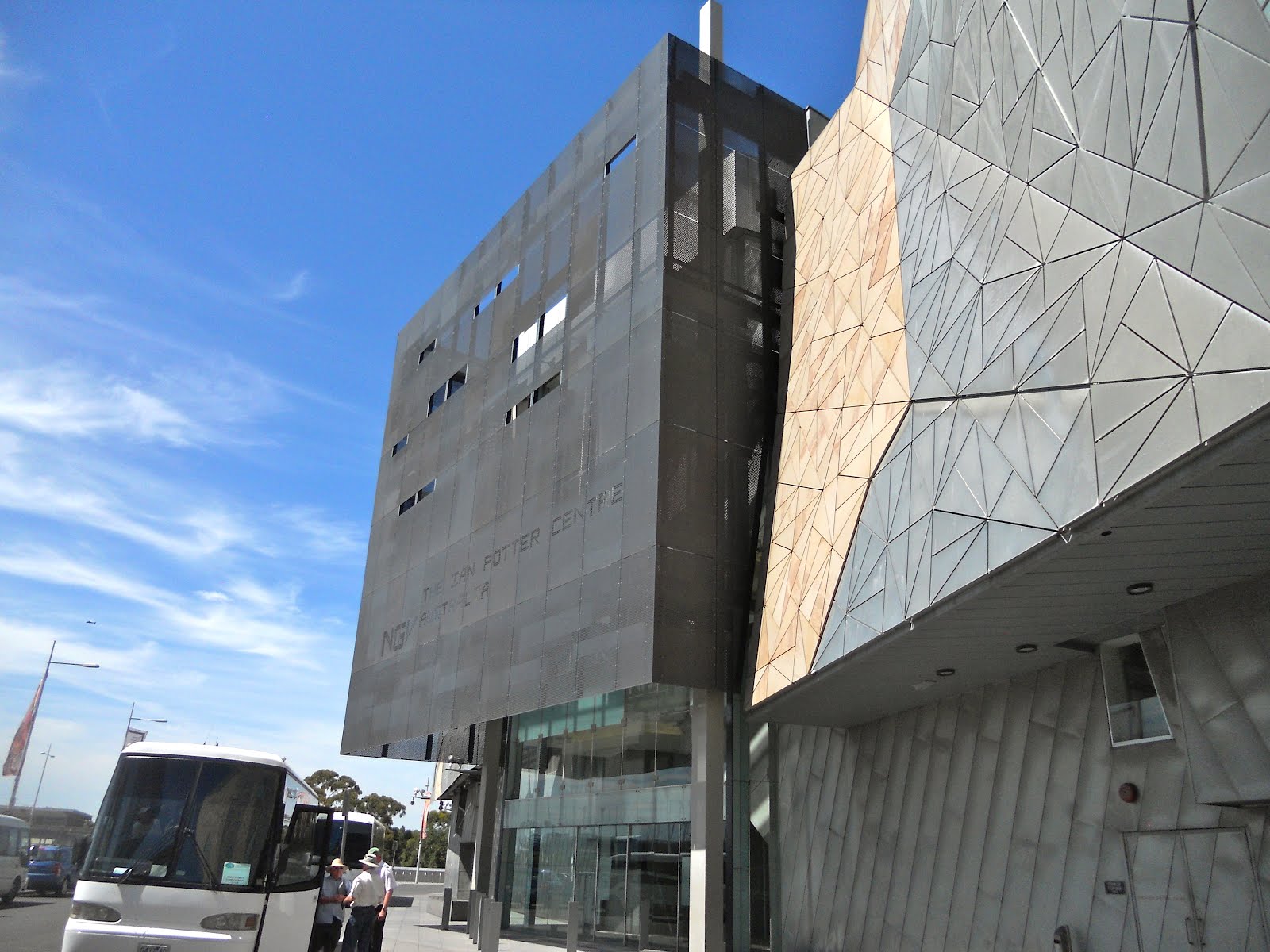
We headed out this morning to go to the exhibit of central Australian aboriginal art, Tjukurrtjanu, at the Ian Potter Center of the National Gallery of Victoria, We walked down the hill to the museum, about two miles from our BnB, along Lygon Street, and its many Italian restaurants and a smattering of other nationalities, into the Central Business District to get there. A free city tram, dating from the 1930s, took us part of the way through the CBD to the center.
The exhibit is so overwhelming that we have decided to go back tomorrow when there will be a docent tour to explain it. It’s huge, the art is complex. The society from which it comes is so different from ours. So we couldn’t easily comprehend what it was supposed to tell us and will go back. Can’t wait.
From there we bought our day tram and train tickets to get out to dinner tonight. With those in hand, we boarded a very crowded tram to St. Kilda, full of students on the way to the beach, to escape some of the heat and have lunch.It was about 94F (35C) We got to Luna Park, which is now totally restored from the ruin I saw 15 years ago, and then searched for lunch. We found it at a very nice sidewalk cafe-restaurant Sugar Reef on Fitzroy Street. We had a couple of salads---Ben had a pear and walnut salad. John had a Greek salad, and a Yak beer. Then we boarded a tram back into the city, walked by Brunetti for Ben’s coffee, today with a map of Tasmania textured in the froth.
Yesterday with our friends was a hoot. Libby and Jane’s mother, Mary, was there. She’s about the same age as our mothers would have been today...a war bride who came to Australia in 1946 and has lived all over the world since then with her husband. Her daughter Libby and husband Geoff have sold their home and are moving out next month, after 30 years there. We ate in the garden, enjoying the beautiful summer evening with the wine flowing at swimming pool levels. All of it went so well with the delicious smoked trout, the loin of pork, various salads and a sweet and crispy meringue with fresh strawberries and blueberries dessert. The conversation flowed as well among the friends, and son Tim’s mates who had visited us in the States 7 years ago. Nice to see TK and Chris and meet Chris’ fiancée. Tim’s g/f Sara is a delight. Everyone at the table had been to America,and other countries so it was an international evening.
We did manage to find the Southern Cross in the heavens and see Orion the other way up!
Home about 12:30 AM--a very late night for us.
Tonight it’s Attica, one of Melbourne’s leading restaurants in the suburb of Ripponlea. A train ride away.