Monday, January 16, 2012

Mad Platz in Melbourne


Monday, January 16

Melbourne is a huge and sophisticated city. We decided to explore parts we’d never seen on our previous trips as well as visit some of the places we’d loved.

Our BnB is in Carlton, named 169 Drummond Street, north of the Exhibition Hall and close by the old Italian part of town, Lygon Street. The house is an old 1860s Gold Rush terrace house with typical wrought iron gingerbread and porches overlooking the street. The host, Ian, is helpful and a good guide with good suggestions. Last night he supported our friend Jane’s son, Gus, who had suggested that we have pizza at the local restaurant D.O.C., which stands for demoninazione di origine controllata. The pizza was superb, light crust, fresh buffalo mozzarella, truffles for Ben with broccolini, and speck and wild mushrooms for John. A carafe of house white, a Crittenden donora. We sat comfortably outside in the evening air.

Ian’s major suggestion today was to use the Melbourne Tourist Bus, a red single-decker, that runs on a 30-minute schedule in a 90 minute loop around the city.

We took it down to the old central business district and the Queen Victoria Market (closed on Mondays), through the significantly changed western part of downtown that has been turned from derelict docks into a city of the future, with apartments, boating slips, sports venues, and shops in modern, and not always brilliant, style. We passed through the botanical gardens and the War Remembrance Memorial off St. Kilda Road, passing the TV and movie studios, theaters and art centers that make Melbourne the arts and culture capital of Australia.

We took a step down from the bus at the National Gallery of Victoria, founded when Victoria was an independent colony and Australia had not been established as a federated state (hence the National), and noted that it had a major exhibit of German inter-war art, including a significant mention of Dada, modernist design, and expressionist artists like George Grosz and Max Beckmann. It also included film work by Josef Sternberg and Fritz Lang, the former including Marlene Dietrich in Blue Angel (1930) and the latter, Metropolis (1926). We went.
The Exhibit was called the Mad Square, German Art 1910-1937.

Lemme tell you, it’s depressing. It’s not lovely. It has some fascinating bits to it, as the Germans came to grips with the despair of their lives, the degeneracy of 1920s Berlin (think Cabaret), the influence of modernism in architecture, including massive housing centers, and the rise of the dictatorship in the 1930s. John enjoyed some of the Dada, but by and large it is a foreboding kind of exhibit, with our having the retrospective knowledge of how bad it got afterwards. Worth the time we gave it.

We walked from there up St. Kilda Road, which John finds one of the grand boulevards of Western Civilization, across the bridge and past Federation Square, new to us, with its additional National Gallery building that houses Australian art, including Aboriginal art. Tomorrow. The building is almost Gehry in its design, with various angles and different planes interacting to give it a post modern look.

After that we lunched in Chinatown at the Dragon Boat, a dim sum restaurant, which was good, and had a spiced green tea that was excellent. We took the Tourist Bus back to Carlton, got off an went to Brunetti for coffee.

Brunetti is one of the world’s great pastry shops. It’s even well enough known to make it into the New York Times. Ben refused to allow John a pastry; instead we ordered two superb coffees, including Ben’s requisite XXX-dry skim cappuccino with texturing and art-work in the foam. This texturing came with map of Australia!

Now it’s off to dinner with friends Jane, Geoff and Libby, with their sons, Tim and Gus, and Tim’s mates he brought to Washington years ago during their Overseas Experience...and stayed with us for BBQ and Bourbon almost 8 years ago.

Saturday, January 14, 2012

Shake, Rattle and Roll

Sunday, January 15


Christchurch, early Sunday morning with only the birds chirping and the sun shining, after a restless night, John decided to write. It was a rough night. About 2:47 AM as he was falling back to sleep after a short waking, the ground shook with what he estimated was a 4.0 earthquake. The building moved a bit as it shivered from the the shaking earth. Hard to fall back to sleep. Ben slept through it! It was in truth a 5.0 earthquake. Here’s the official posted report:


It was only the second time we had felt an earthquake, the first being Washinton’s August shaker. And It was a rather funny coincidence. Just yesterday afternoon the taxi driver bringing us back to the Argyle on the Park from Christchurch Station had said that the quakes continued and he expected one last night. Of course earthquakes are not quite that predictable, but he was right on. I suppose later this morning we’ll venture toward downtown to see a bit of damage. Not to gawk, just to sympathize with the Christchurchers who live with them so regularly as they continue to rebuild after the two that razed their city center. (We did take a walk, and the damage is substantial, but at the same time the strong-willed Christchurchers still continue to punt on the Avoon and have taken up rebuilding.)


We’ve had a busy two days of train travel. We awoke on Friday morning to pouring rain with heavy thunderstorms waking us during the night in Picton. We had our breakfast at the Broadway, a fine, newish motel, at the top of the main street, left our bags and went to explore the tiny town before leaving at 1 PM for Christchurch. Not much to see, so we bought sandwiches at the Bakkerij Picton, a Dutch-founded pastry and bread shop, and headed for the station. It was a good ending to our days in the Sounds area of the South Island.

The train ride south to Christchurch is long but quite pretty. It passed many small towns on the East Coast of the island, making few stops. At various points the tunnels show how hard it has been to build rail lines in New Zealand as they go through the promontories into the Pacific. The line was begun in the 1860s but not completed until 1945, in part because of wars, in part because of politics! The train passes salt flats, fields, loads of sheep and cattle, and then races across the Canterbury Plain around Christchurch to the city.


We are staying in Riccarton, on the west side of Hagley Park, a pleasant suburban neighborhood. The Argyle is a pleasant motel with a full kitchen and a bedroom in our suite. No breakfast for free, but we got supplies at the local superette. Around the corner is a restaurant row where we have eaten both nights here.


Our first evening the motel owner suggested the Running Bull in a hotel at a nearby corner, a very loud young folks bar, but with a very good restaurant. We got two small salads to start, John had a sauvignon blanc from Marlborough and Ben ordered a local pinot noir. We coupled this with a Canterbury Tray of meats and vegetables: this was a huge cutting board of lamb shoulder, roasted slowly and very juicy, covered in a red wine reduction, green beans steamed to crispness, a mixture of kumara, carrots and parsnips, some fresh sweet peas, and rosemary potatoes. It was a huge amount of food, which we didn’t quite finish, but it was just what John wanted, he admitted sheepishly.


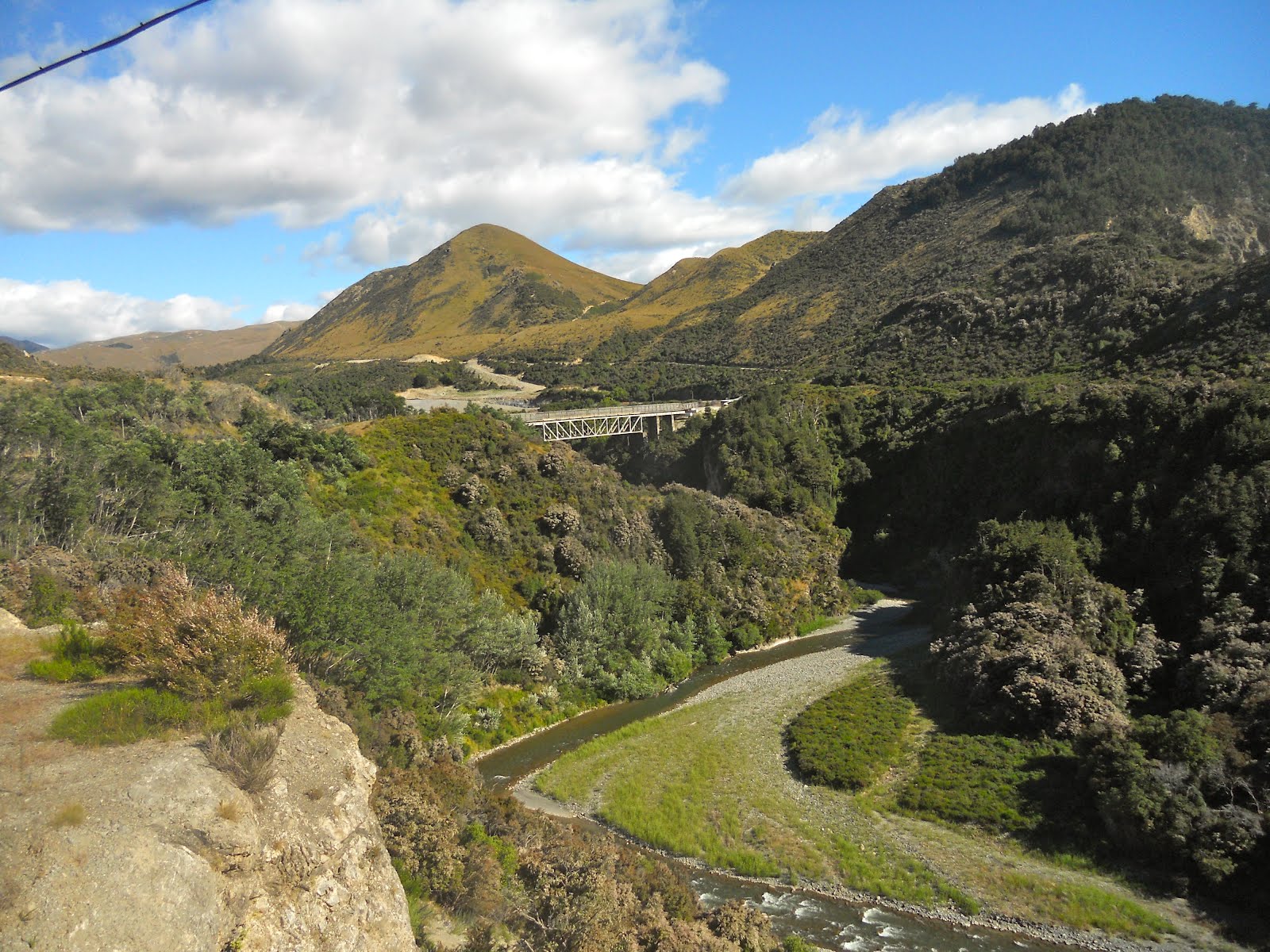
Yesterday, Saturday, was an all day excursion over the Southern Alps to Greymouth on the West Coast. This is an 9 hour trip, leaving at 8 AM returning at 6 PM with an hour in Greymouth for lunch. The trip is listed as one of the world’s great rail journeys, and it truly is. It follows the Waikikiri River Gorge on the eastern slopes as the train climbs about 700 meters (2,300 feet), through 21 tunnels and over three major viaducts. At sea level and for some miles the ride is through agricultural lands with the mountain vista visible to the West. Then the climb ride is through scruffy yellowed hills, reminiscent of parts of the American West until reaching a spring-like Alpine peak. it rains intermittently as the trains pass under the low-lying clouds. At Arthurs Pass in the national park, the train begins a descent through a five mile long tunnel to Ohira which is the geographical divide of the South Island.


While there isn’t much snow at this time of year--it is mid-Summer--there was still some snow on the sides of the peaks. Not as much as Montana or Alberta’s Rockies, but still visible. Clearly much of the snow had melted evidenced by the waterfalls and swollen, rushing rivers.


The ride down on the eastern side to the sea follows two rivers, with evidence of old mines and passing coal trains on sidings where the track doubles to allow two way traffic on what is mainly a single track ride. New Zealand’s trains run on a 3’6” gauge, considerably narrower than the Americas’ or Europe’s 4’8.5” gauge.


Greymouth is small, population 10,000 and we were not there long enough to explore for more than a place to have lunch. We found a suitable coffee shop, Ben had a small muffin with his textured cappuccino and some of John’s breakfast, which was very good--meatless but with good bread and lovely roasted tomatoes to go with the poached eggs.


The train home gave us chance to see the trip from a different angle, trying a bit to converse with the Russians from Vladivostok across the aisle. John’s 50 year-old Russian was not up to it, but he did manage ‘khorosho’ and ‘spasibo’. ‘Fine’ and ‘thanks’, which impressed the Russians a bit, only one of whom spoke English!


For dinner we looked through our list and checked local listings. We found a table outside at a local eclectic place about ten minutes walk away. Treviso served us whitebait, a local delicacy, a tiny fish, about an inch long, in an omelette as a starter, followed by gurnard for Ben and lamb grilled for John. The woman who recommended the whitebait, Brenda, had a good long conversation with us and then introduced us to her husband after we had finished our meal and they were on a cigarette break.


The wine was a Central Otago pinot noir, a Mount Difficulty, Roaring Meg, recommended by Brenda, and the waitress, from the southern part of the South Island. On arrival John had had a Old Mac Gold ale, which was not as deep in taste as the Tui in Auckland, but a good quaff.


Thursday, January 12, 2012

Sauvignon Blancs, Mussels and Sounds

Aussie, the driver who had driven friends Kevin and Tim on their visit to the South Island some years ago and nicknamed because he comes from Western Australia, picked us up with a delightful lady from California, Pat, and one of his co-workers, Campbell, who had just joined the Malrborough Travel Company.


We headed off in the van, the five of us, for three wineries about 930AM. The firsts stop was Saint James Winery, a pleasant place started as an apple orchard making fancy chutneys and jams before changing into a winery. Now it is a major player in the pack of sauvignon blanc makers. We tasted their range, particularly liking their pinot noir and their sauvignon.


From there it was Framingham, which makes the sauvignon blanc that Marlborough uses on their boat to go with the lunch of mussels. The sauvignon blanc was superb with the mussels. It is clearly a food wine. We tasted the reislings, not much to either of our tastes, their montepulciano, which is very nice and has a hint of Italy, but no Italian terroir, about it. The pinot noir was lovely and their dessert wine won Pat’s heart.


The third winery, one of the area’s largest, we believe, was Wairau, named after the local river. Very nice, but we’d say it was generally our third choice. Perhaps our tastes were a bit jaded by this time, having tasted about 15 wines over the 120 minute tour.


Nonetheless, all the wines were superb. We were not into the reislings much, John decided that Framingham’s viognier made him realize that not all viogneirs are to be avoided, and the chardonnays are not like California’s or Australia’s They are not upfront like the Aussie wines and not as full or buttery as California’s. They are much more burgundian or even northern alpine Italian in style.


We drove then to Havelock, the town where Marlborough Tours docks its cruiser. We lunched at Slip Inn in Havelock. Ben had a broccoli, cauliflower and zucchini cream soup, while John had a Thai beef salad--once again no chili had set foot in that kitchen. A nice salad but nothing Thai about it except for a few fried noodles.


Then it was off to the boat to be joined by another group, making our tour about 15 people. The boat is good sized, probably about 60 feet, built as a catamaran so it is able to go over the lines of the mussel farms. We cruised down the Pelorus Sound past hills of trees with occasional vacation homes, some with all the links to civilization except roads.


Our goal, the mussel farms, line the sides of parts of the sound. The mussels hand on ropes from the lines attached to floats and are harvested into huge ton-sized bags for quick processing and flash-freezing and shipment overseas. We enjoyed big bowls of mussels, most with a bit of lemon or nothing at all, but wasabi and Thai sweet chili sauce were available. Fresh mussels caught within hours area real treat. Particularly the large green shelled NZ mussels which grow nowhere else in the world.


We tasted some flash frozen ones after the bowls of fresh. While good, even excellent, there is no comparison to the mussels right out of the sea.


The trip back to land was in rain-showers but even then it was a good time, chatting with the mostly Aussie tourists from places like Adelaide, the Deep North and Canberra.


We dined at Le Cafe in Picton last night. Ben had a gudjon, a white fish, with vegetables, while John had a bowl of oricchiete with olives and tomato sauce. We began with some grilled, cooked on a hot griddle, asparagus with sweet-ish ham and a ciabatta John had a First Landing sauvigon blanc to start and we drank a bottle of pinot noir from Serenis winery. A very lovely table outside looking at the sound, the mountains and their cloud-shrouded summits.


After dinner we stayed for a small cabaret of Brazilian music. While the pieces were good, and probably the players good, the group really needs manager or director to rehearse them who can assess the sounds they make. Not the greatest yet, but they could be much better. We wondered what a young woman, obviously the local paper’s critic, at a nearby paper will write about them.


We watched a bit of the local news before crashing to sleep. It is AWFUL. There wasn’t a story of substance among the first 15 minutes of the program. Death--a kid killed in a train tunnel while putting graffiti on the walls with his wailing mother and aunt, and a friend who blithely remarked that “he died doing what he loved!” Loss--another piece on a locket full of 1949 birthday pictures found in a Wellington house by the new owner, led to a story about a 83-year-old getting them back and promising to take better care of them. And this is news? Worse than WPXI. The newspapers are the same.


Oh, well.

Off to the South Island

Wednesday, January 11


We repacked and are ready at the terminal for our Islander ferry to Picton, at the north end of the South Island for our last four days in New Zealand. It’s a beautiful day so the crossing should be glorious, with the sun on the waves and the mountains crashing down into the sea. We’ll see.


Last night’s dinner was a hoot. Capri Bar, recommended by our friend James, is in Wellington’s central business district, not far from Parliament and in a nest of high rise office buildings. We took a trolley bus over from the hotel and arrived spot on, to find only one other couple in the restaurant. The owner, Andy, explained later that no one really stays much in Wellington in January, the height of the summer vacation period, so not much clientele.


We had seen the menu earlier when we made the reservation, so John had decided on Venison Wellington as his main course. Ben listened to the fish of the day, a blue nose, the local grouper, and chose that. But we didn’t want a heavy appetizer, so we talked to Andy, who had the chef make two lovely lettuce, arugula and tomato salads for us to start. Ben decided it would be a pinot noir to go with the meal, so we chose a Margrain Martinborough Rivers Edge Pinot Noir 2009. What came was a 2008 and it was superb! Lovely bouquet, nice finish, good taste all the way around.


John’s venison was lovely, with a mound of roasted potatoes and Ben’s grouper was a beautiful white tender meaty fish, full of flavor, topped with a nice slice of chorizo! We did not have dessert, instead spending a goodly time chatting with the owner. Turning 30 and getting married! Obviously enjoys running his restaurant and knowing about food and wine. We got a good course that added to our knowledge of the various NZ wines. The country has quite a viticulture. Andy finds Gibbston pinot noirs from the South Island a favorite. We’ve never seen them in the US.


This morning we headed off to Te Papa to finish of the exhibits we had wanted to see. We checked out in detail the Maori exhibits including the buildings and then looked over a history of immigration into New Zealand and the push for human rights in the country in the 1980s, including the move for gay rights and women’s rights.


The hotel, At Home in Wellington, lived up to every expectation. Comfortable bed, good shower, wifi, nice view of the harbor and close to everything, particularly the Te Papa museum and busses into the CBD. We even left them our clipping from the New York Times about them as a place to stay that they had heard about but not actually seen. Good fun.


We boarded a few minutes late, but were lucky; the 10 AM crossing had been delayed so people had missed their train and cruise connections in Picton. One couple, from the French island of Réunion in the Indian Ocean had another 75 miles to travel before they could rest--and on back country New Zealand roads that wiggle and wind that is a long way.


Crossing Cook Sound was easy. Some days it is incredibly rough, it’s said.
It is apparently one of the most dangerous sounds in the world. The wind was quite incredible. Enough to bring Ben inside.


We had a couple of sandwiches and coffees, which met specification. Arriving into Queen Charlotte Sound, named after George III’s wife, was awesome. It’s not a fjord, but it is lined with high hills and mountains in the distance, some cloud-capped. The ferry, which is the size of a smallish cruise liner, ploughs up the sound at a 20 mph pace rounding points at each time the views continue. Picton comes up about 40 minutes later, a smallish town, at the head of the sound where the rail connections to the rest of the island connect. The Arawatea, our ship, carries whole trains that connect to the lines in the south island.


The engines that shunt the freight cars onto the ship are all remotely operated and only three or four crew go in with each section of freight cars, broken up to fit in the hold, to make sure that cars are stowed correctly. Quite a sight.


We walked up to the hotel, about half a mile, the Broadway. It’s on a busy corner, near the rail line, but otherwise is excellent. No breakfast so John went shopping at the supermarket across the street for two days-worth of breakfast. The whole think of coffee, scones, muesli, yoghurt and lots of soft drinks (John gets thirsty) was about NDZ 25, which is about the same price as breakfast for two one day. Groceries are expensive here, about 20 percent more than in the States. Gasoline seems to be about USD 6.50 per gallon. It’s NDZ 2.20 per litre.


Dinner at the Oxley was not bad last night. It’s a pub on the front overlooking the harbor. We ordered seafood chowder with ciabatta for Ben, which was excellent. John had a venison burger, which was also good, with a Speight, local, ale. We wondered back up the hill through the High Street, a bit wide, empty road with shops on either side to the motel and to bed.


Today we head off wine tasting, in about 15 minutes and then go on a cruise on several other sounds finishing with mussels from a green-lipped mussel farm. On to the wineries!


Monday, January 9, 2012

Trolleys, Transit and Trees


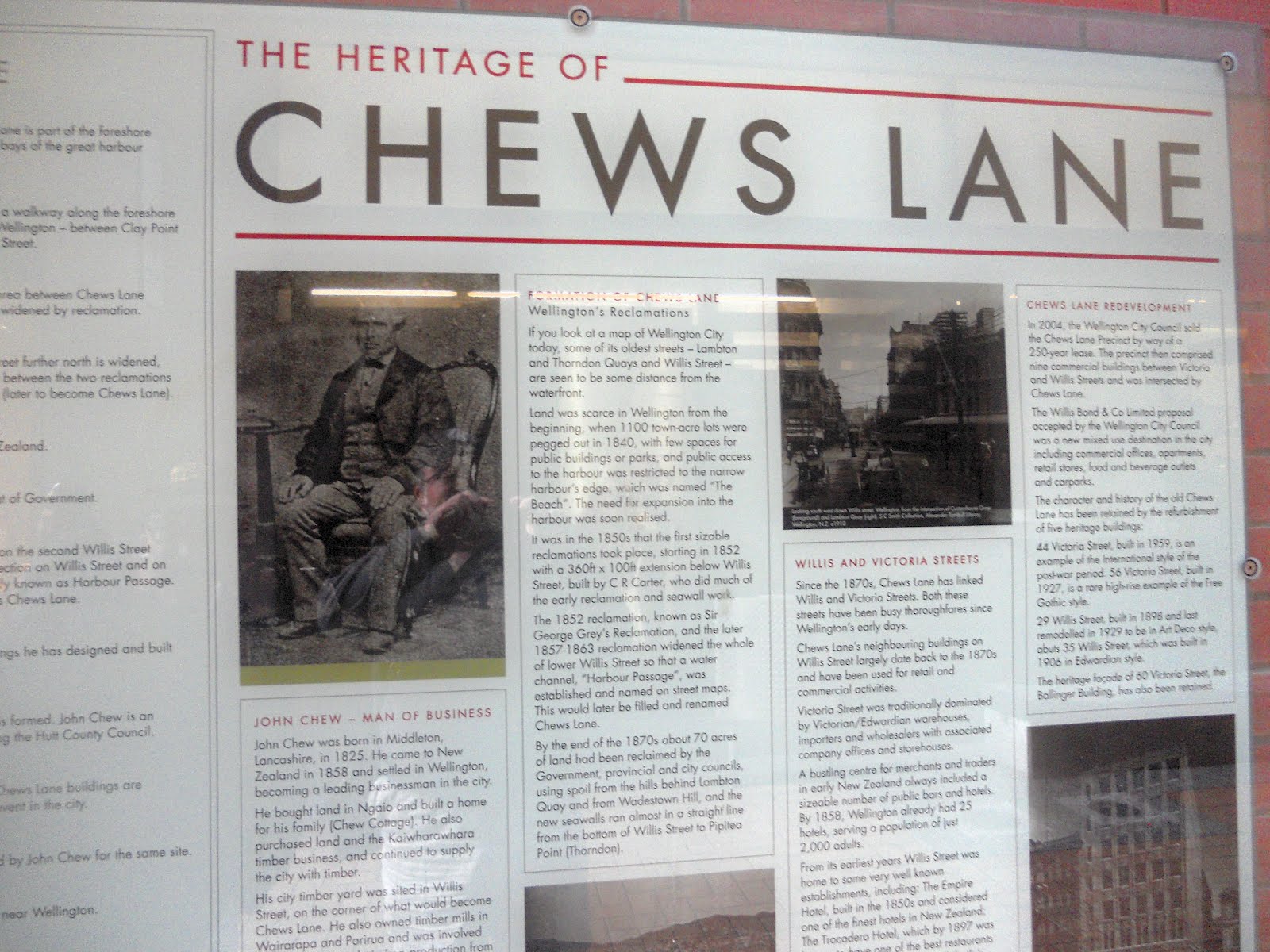
Tuesday, January 10: Coffee at a restaurant on the waterfront overlooking fountains and the Wellington skyline with good yoghurt was not a bad way to start the day. We walked through the downtown of this rather vibrant little city (it’s about 400,000 in the metro), stopping at various statues, and noting a lane, Chew's Lane, now a passageway between buildings, that was named after a gent from John's hometown of Middleton, Lancashire, England.


Then we rode the cable car to the summit.

At the top is a museum to Wellington and New Zealand’s trams and cable cars, which had a rather good movie presentation. Of course the view at the top is quite spectacular with a vista of hills and house similar to San Francisco or Seattle. Wellington has more physical charm than Auckland.

The walk down through the Botanical Gardens, with the many different varieties of flowers, shrubs, grasses and trees was a learning experience. As far as we can make out just about anything will grow here with the mild damp climate: there were even grand succulents in one of the gardens. There was even a sundial where Ben was the indicator! The area outside the Gardens is a mostly Victorian part of town, some of the houses looking as it they date back to the original founding in the mid-19th on tiny Ascot Lane.


From there we walked down the hill, had a look around the outside of Parliament and the Beehive, the building that houses the
Cabinet of the unicameral legislature. We stopped in nearby downtown to make dinner reservations and then boarded a trolley bus for an hour of riding.

John has been an avid rider of trolley busses, and couldn’t pass up a chance to ride the only system in Oceania. It makes up for Edmonton, where the busses were stopped the day we arrived in that Alberta city. Here they are all new and roam the hills on many different routes. The clunk as they go through the intersections and the whine they give off alert the unsuspecting of their arrival. Ben enjoys the ride and watching the people. We bought an all day bus ticket which we will use again tonight as we go out to dinner downtown. We took route 11, maybe the city’s longest, from downtown to Seatoun and back. It runs through a couple of tunnels and even has to run on a broad arterial highway as it connects various city neighborhoods. Many of them are composed of a wide variety, though very English style, bungalows--made of wood rather than brick.

From there we stopped at a grubby noodle house for lunch. Surprisingly the curried chicken noodles for Ben and a spicy Thai seafood noodles for John were very good.

Now to Te Papa, the national museum. It's protected from earthquakes by massive rubber footings! It’s an imposing edifice on the waterfront, and we went to see new Maori art. Along the way we saw an exhibit of the Treaty of Waitangi, where the Maoris gave the British the islands, so to speak. However, the Maori collection is nowhere near as good as the Auckland War Memorial Museum, nor, surprisingly, was the Maori art as good at the Auckland Art Gallery’s collection. One of the docents explained that they didn’t have much on show, having put some of it away for a while. We returned to the hotel and are readying for dinner tonight, where John expects to have Venison Wellington!

,

Deco, Drizzle, Dinner Delight and Detours


Sunday, January 8


We are about to go out to dinner in the art deco hotel where we’re staying on the Pacific in Napier. Napier is about as art deco as you can get. In fact, it’s a heritage site (if not UNESCO, certainly with the NZ government.) The architecture here is a perfection of art deco almost unknown in the whole world.


The place had an earthquake in February, 1931, decided to rebuild in reinforced concrete and the city fathers realized that the best style, and cheapest style for the day, was deco. Hence street after street after street of beautiful art deco architecture. Come the 1980s, the city fathers thought about redoing the whole place, but an arts advisor from London convinced them that deco was beautiful and they had the best example of it, en masse. Hence, restoration and rehabilitation began, and after 25 years, the place is just lovely. In fact, they are still discovering some of the art deco pieces when some of the buildings which were redone in the 50s, 60s and 70s. Some of the deco had been covered over so now the restoration does some fixing. Walking down the streets is like transportation back to the 1930s. Buildings in California mission style abut ziggurats and speed lines to create an entire downtown, still in use, like our hotel, the Masonic Hotel, rebuilt from ruins in 1933.


This is what an old hotel should be like. Charming reception, charming bits and pieces, lovely rooms, if old, but not worn out. Just great. We’re off to the hotel restaurant for dinner because it’s Sunday in a small NZ town.


----


Tuesday, January 10


Yesterday, we didn’t get much chance to write since we spent most of the day on a bus.


The restaurant, Med, in the Masonic Hotel was lovely. The receptionist was half-Maori, half-European and very very cute. A wry gay wit, so to speak. He stronjgly recommended trying a group of Hawke’s Bay wines, the vini locale, so to speak. We started with two: A Trinity Hill, Hawke’s Bay Range SV and a Squawking Magpie ‘The Chatterer’ chardonnay. Ben liked them both, I found the chardonnay to be a bit on the heavy side, though I enjoyed the SV very much. We chose three reds by the glass, a syrah Sacred Hill ‘Halo’, a mix of Malbec and Merlot, Clearview ‘Two Pinnacles’, and a Brookfield ‘Ohiti Estate’ Cabernet Sauvignon. We enjoyed all three, though john was particularly taken with the syrah and Ben loved the Malbec/Merlot.


The chef comes from Goa and uses an Indian style to the food coupled with a few years in the Eastern Mediterranean and then Melbourne, so he also has a Mediterranean style. Ben ordered three appetizers as the meal: oyster shooters, scallops and a dish described as duck cigars, which were like small duck dim sum. John had a green salad with kaimai blue cheese from Matamata (see Hobbiton above) and a rack of lamb done with adobo. We enjoyed it a lot.


In the morning, we decided, since the weather had changed, to put our hands in the Pacific and walked to the Front. Along the way we stopped to look over a 1936 Austin Seven, very tiny, 750 cc engine. The British equivalent of a cheap Ford. They do up the 1930s here big for the deco buildings. A cute young couple, Felicity Dorrington-Smythe and Andrew C. Montgomerery III dressed in period were posing as part of the tableaux of the car.


We had taken the art deco tour the day before so we went back to see some interiors and streets we hadn’t truly explored before. The interiors of what was the newspaper is done very much in a Frank Lloyd Wright style and there are several others that are worth a glance.


We breakfasted at a Ujazi, a coffee shop/lunch/breakfast place, eating outside. Ben had yoghurt and fresh fruit salad, with lovely pineapple and apples. The apples have a milder flavor here, but the pineapples are very full. John tried the local sausages, which are typically British, being mostly bread and fat in a casing. The local bread was good.


After a lingering cappuccino on the mall amidst the deco we boarded the bus about 1 PM for the six hour trip to Wellington. Had the air conditioning been working well this would have been a grand trip. As it was it was a fine tip though a bit warmer than we would have liked. New Zealand’s long distance Inter-city busses are very good, very comfortable and move as fast as they can on the two lane roads. There are very few freeways. We have only seen them in Wellington and Auckland.


The run took us through several lovely mountain ranges, which we could see because it had stopped raining. Stopping in several small towns to pick and discharge we got to see a slice of the rural life of the country. The towns are tidy, but reminiscent of the California central valley with the fields stretching for miles off to the mountains.


A true high point was a detour we had to take because the main road slid down the side of a mountain and was being repaired. It took us through a wind-farm with the aeoliens (windmills) turning in the wind. NZ gets about 60 percent of its power from hydro, 10 percent from geothermal and is expanding its wind capabilities. There is no nuclear.


We arrived in Wellington about 7:15, took a shuttle to At Home in Wellington, our apartment hotel, started laundry--we are still working on figuring out all the heiroglyphs that take the place of words on the machine--and decided on a down home dinner.


We ended up on Cuba Street mall at John J. Murphy’s Pub, complete with Irish music, a Scots chef, Irish and Scots bartenders and big screen cricket. John had very acceptable fish and chips with a Tui ale and Ben enjoyed a seafood gumbo, fresh bread and very nice salad. No ale.


Got back to find the laundry not dry, but we think we have mastered the machine now. Second load goes into the dryer shortly. Now to breakfast and explore Wellington.

Sunday, January 8, 2012

Mud, Maoris and More...

Saturday, January 7 We got up too early this morning, too early for anyone unless he had to catch a bus. 5:45 AM. To make an 8 AM departure from Auckland we boarded a shuttle at 7 AM, traveling by land and bridge to Auckland for the very first time from Bayswater. Every other trip had been waterborne. The bus station was your every day ordinary bus station, but the bus was comfortable, made a number of rest stops, and even passed through Matamata, aka Hobbitton, because that’s where the Hobbitt movies were shot, and Rangitiri, site of a major 1863 battle between the Maori and the British settlers. It poured with rain for most the journey and continued the rest of the day.


We arrived in Rotorua, the sulfurous Maori cultural center, about 1 PM, and made our way to our very second rate hotel--truly dated, clean, but very very midcentury and past needing a fluff...it needs a transfusion. But it is five minutes walk to the Maori cultural center and our bedroom balcony has a wonderful view of a Pohutu geyser that erupts about hourly for twenty minutes each time. Immediately below us are several stinky mudpots, bubbling away.


We got a Grumpy shuttle service, run by some really really old-time New Zealand folk, scruffy, funny hats, big beer bellies, etc., but very friendly (we like bears) downtown for lunch and a walk-around the Victorian/Edwardian buildings that are on all the postcards for this place.


Lunch at the Wild Rice Thai Restaurant was so dumbed down Thai that you could scarcely taste a chili pepper in it. The fried fish cakes had been microwaved and the Thai spring rolls were just too industrial and served with sweet sauce with scarcely a hint of spice. When our pad-Thai arrived, the sauce had a smidgen of gravy-scent about it, not a dab of fish sauce, a couple of pieces of meat,two tiny shrimp, half a scallion, and a smattering of bean sprouts and grated peanuts. There wasn’t even a drop of lime in it, though it came with a small wedge of lemon. John thinks Field Marshal Plaek Pibulsonggram, the World War II head of Thailand, who made it the national dish, would have wondered what happened when the dish crossed the Equator. He almost felt embarrassed for the nice owner, who is from Bangkok.


Then a walk over to the Government Gardens built in the late 19th century with a Elizabethan Tudor bath house modified to fit the whimsical tastes of the late 19th century and early 20th century Victorians and Edwardians. We didn’t go in, though the building is magnificently large and very well restored. John glanced inside and thought “this wooden staircase and grand building wasn’t worth NZD15 for a tour.”


The hotel site with the geyser erupting 200 yards from out balcony is also an easy walk, even in the rain, to the Te Puia Maori Center up the road.


As John looks back on the last few paragraphs, he thinks anyone reading this should not be turned off by what we had done earlier in the day because the experience we had last night was so exhilarating, enjoyable and truly well-done touristy evening, compared to the rest of Rotorua.


The Maori guide at the center, Carla, had a wonderful sense of humor as we walked in the rain through the Maori buildings, learned about where the Maori came from (the rest of Polynesia and probably originally from Southeast Asia), how they got to Aoroatea (the Land of the Long White Cloud, the name the Maori explorer KupI gave to New Zealand), and then a tour of the art school and weaving school.


The evening, though, was a grand climax of show of Maori welcoming ceremonies, Maori dances and war chants and then a hangi dinner of grand proportion, begun with mussels and corn as a welcoming gesture. The meat, chicken, lamb and pork, was cooked under hot rocks, basically steamed, along with kumara sweet potatoes and other vegetables. For a New Englander, it’s a clam bake using meat and hot rocks rather than seaweed and clams and coals. The rest of the meal though, done buffet style, was lovely: huge fresh oysters, huge green-lipped mussels, prawns (shrimp), octopus and a variety of salads. Considering that the Maoris had eaten birds, sweet potatoes and a few ferns before the Europeans arrived, this was quite a cuisine brought to the islands from elsewhere. [Note that the peppers, corn, potatoes, squash, and tomatoes were all developed in the Americas before Columbus arrived and brought to this part of the world. Virtually nothing we ate was indigenous.]


New Zealand has NO native mammals and no snakes, just birds, fish and a few lizards. It is not what you would consider a harmful environment. You can’t meet a bear, deer, raccoon or rattler if you move off a trail.


We finished the evening with an hour long conversation of travels and politics with a group of Aussies (four from Perth and one couple from McLaren Valley) at our table, who had traveled to the US and were looking for more things to do there. Of course, they were impressed that next week is our fourth visit to Australia.


Today we catch a bus to Napier. We hope the hotel is better than the Silver Oaks Geyserland.